What It Does#
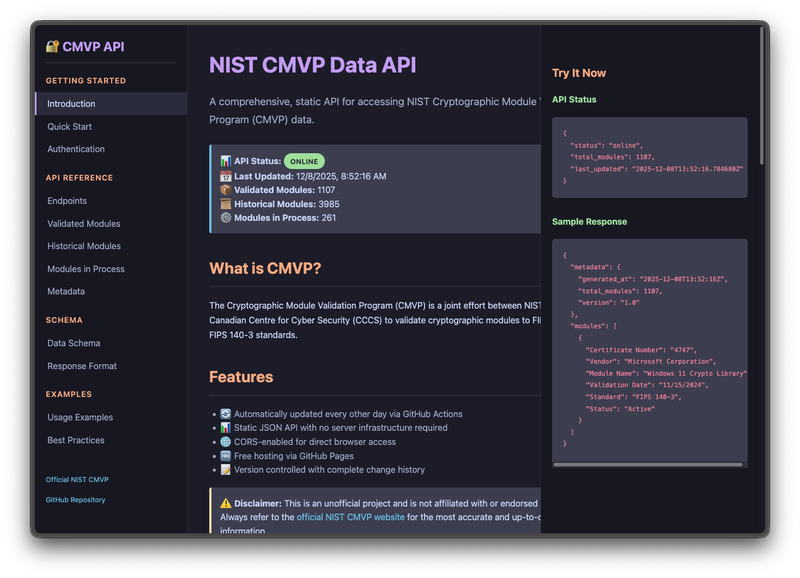
Scrapes NIST’s CMVP database and serves it as a static JSON API via GitHub Pages. Data refreshes weekly via GitHub Actions.
How It Works#
The pipeline runs automatically via GitHub Actions:
flowchart TD
    subgraph Trigger
        A[Weekly Schedule] --> D
        B[Manual Dispatch] --> D
        C[Code Push] --> D
    end

    D[GitHub Actions Runner] --> E[Setup Python + Playwright]
    E --> F[Initialize crawl4ai]
    F --> G[Run scraper.py]

    subgraph Scrape["Scrape NIST CMVP Site"]
        G --> H[Active Modules]
        G --> I[Historical Modules]
        G --> J[In-Process Modules]
        G --> K[Algorithm Details]
    end

    subgraph Generate["Generate JSON Files"]
        H --> L[modules.json]
        I --> M[historical-modules.json]
        J --> N[modules-in-process.json]
        K --> O[algorithms.json]
        L & M & N & O --> P[metadata.json]
        P --> Q[index.json]
    end

    Q --> R{Changes?}
    R -->|Yes| S[Git Commit & Push]
    R -->|No| T[Skip]
    S --> U[GitHub Pages Deploy]
    U --> V[Static API Live]
The scraper uses crawl4ai, an AI-friendly web crawling library built on Playwright. Playwright handles the browser automation needed to navigate NIST’s JavaScript-heavy pages, while crawl4ai provides clean extraction of the module data.
GitHub Actions runs the scraper on a weekly schedule, commits any changes to the repo, and triggers a GitHub Pages deployment. The result is a zero-infrastructure static API that stays current without any servers to maintain.
Data is sourced from NIST’s official CMVP database.
Why#
NIST’s CMVP site is clunky to query programmatically. This gives you clean JSON endpoints for:
- Currently validated cryptographic modules
- Historical/expired modules
- Modules in the validation process
Use Cases#
- FedRAMP/FIPS compliance checks
- Vendor crypto module lookups
- Building tools on top of CMVP data (like the NIST CMVP CLI)
Disclaimer#
Unofficial project - not affiliated with NIST. Verify critical info against the official source.